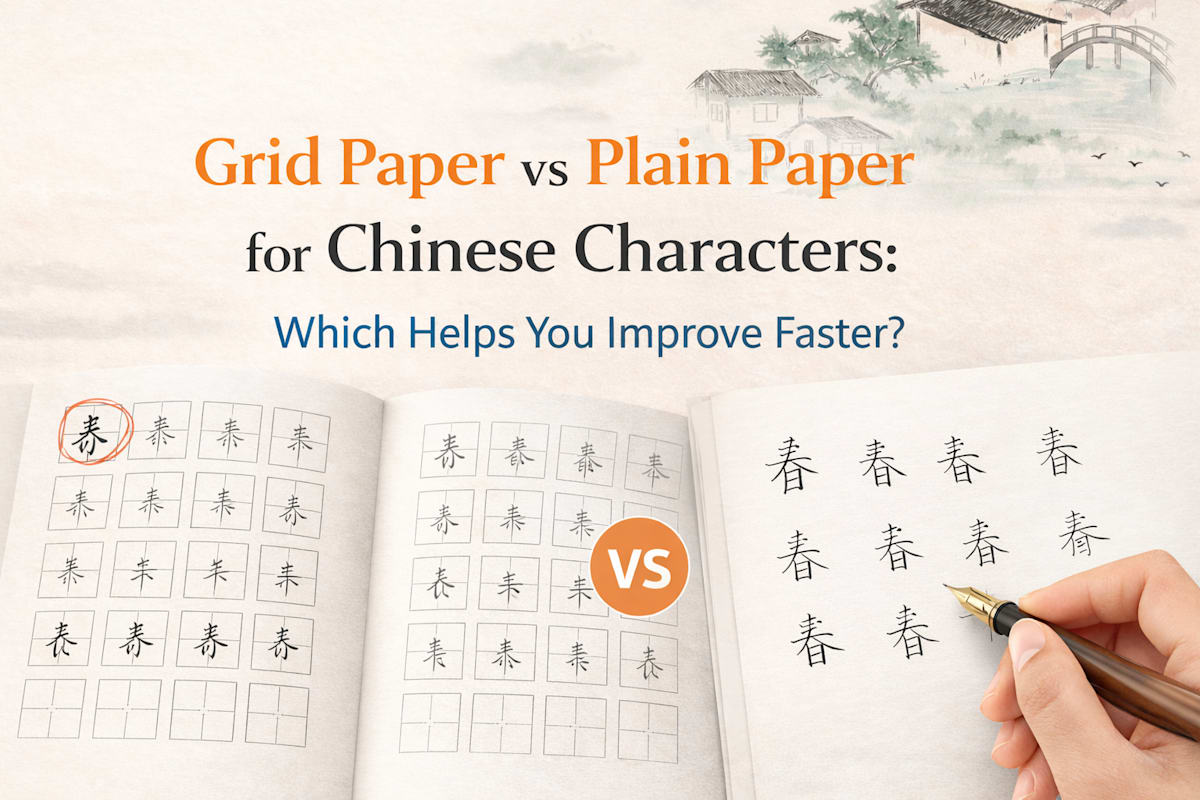
When practicing Chinese characters, the paper you use matters more than many learners realize. While plain paper may seem flexible and simple, it often makes handwriting practice harder than it needs to be—especially in the early and intermediate stages of learning.
Grid paper, particularly Tianzi (four-square) layouts, provides a structured environment that supports balance, spacing, and long-term handwriting improvement. Understanding the difference between grid paper and plain paper can help you practice more effectively, reduce frustration, and develop clearer, more consistent Chinese characters over time.
The appeal of plain paper
Plain paper feels open and unrestricted. Many learners are drawn to it because it looks clean, minimal, and closer to “real” writing situations. It can feel more natural, especially for those already comfortable writing alphabet-based languages.
However, plain paper offers very little guidance for Chinese handwriting practice:
- No visual reference for spacing
- No consistent frame for character size
- No immediate feedback when balance is off
Because of this, small spacing and proportion errors often go unnoticed. Characters may slowly grow larger or smaller, drift upward or downward on the page, or become crowded without the writer realizing it. Over time, these habits become harder to correct.
Why spacing is especially important in Chinese characters
Chinese characters are not written linearly like alphabet-based scripts. Each character is constructed within an invisible square, with strokes arranged in relation to one another rather than flowing left to right.
Without a visible frame:
- Characters easily become top-heavy or bottom-heavy
- Left and right components lose balance
- Stroke density becomes uneven
- Proportions vary from one character to the next
These issues don’t come from a lack of vocabulary or understanding. They come from a lack of spatial structure on the page.
How grid paper changes the learning experience
Grid paper introduces gentle visual boundaries that guide the writing process without restricting creativity. Tianzi grids divide each character space into four equal sections, helping writers understand how a character occupies space vertically and horizontally.
This format helps you:
- Maintain consistent character size
- Place strokes with greater confidence
- Recognize balance problems immediately
- Develop stronger muscle memory through repetition
Instead of guessing where a character should sit, your hand learns to align naturally within the grid. Over time, this spatial awareness carries over even when the grid is removed.
Visual feedback and faster correction
One of the biggest advantages of grid paper is feedback. When writing on plain paper, mistakes can feel vague—something looks “off,” but it’s hard to pinpoint why.
With grid paper:
- Crowding becomes obvious
- Off-center strokes stand out
- Uneven proportions are easy to see
This immediate feedback allows learners to adjust quickly instead of repeating the same mistakes.
Why grid paper is better for building habits
For most learners, progress comes from repetition and consistency. Grid paper supports this by making practice repeatable and measurable.
With a structured layout:
- Each character begins in the same space
- Rows remain aligned
- Progress is easier to compare from page to page
- Writing feels calmer and more intentional
This makes grid paper especially effective for daily handwriting routines, warm-up exercises, and focused repetition of difficult characters.
The role of muscle memory in handwriting
Chinese handwriting is a physical skill as much as a cognitive one. Muscle memory develops when the hand repeats the same movements within a consistent spatial framework.
Grid paper reinforces:
- Stroke length awareness
- Spatial relationships between components
- Controlled hand movement
Plain paper, by contrast, forces the hand to re-establish proportions with every character.
When plain paper can be useful
Plain paper isn’t useless—it simply works best after structure is established.
Many learners transition to plain paper once:
- Character proportions feel natural
- Spacing remains consistent without guides
- Writing confidence has increased
Even at advanced levels, grid paper often remains useful for:
- Warm-up sessions
- Reviewing difficult characters
- Correcting bad habits
- Slowing down rushed handwriting
Choosing the right paper for long-term progress
If your goal is to improve handwriting clarity, balance, and consistency, grid paper offers clear advantages. It reduces guesswork, shortens the learning curve, and turns practice into a steady, repeatable habit.
Plain paper may look simpler, but grid paper makes practice more effective—especially when you are still building control, awareness, and confidence.
Grid paper and learner confidence
Many learners underestimate the emotional side of handwriting practice. When writing feels messy or inconsistent, motivation drops quickly.
Grid paper helps restore confidence by:
- Making improvement visible
- Reducing frustration
- Creating a sense of order
- Encouraging slower, more mindful writing
This psychological benefit is one reason grid-based practice is widely used in traditional Chinese education.
Final thought
The difference between grid paper and plain paper is not about rules—it’s about feedback.
Grid paper gives your eyes and hands the guidance they need to work together. Over time, this structure leads to cleaner characters, better spacing, and more reliable handwriting.
If you want to practice Chinese characters in a way that feels organized, repeatable, and effective, starting with a well-designed grid layout can make a noticeable difference—one square at a time.
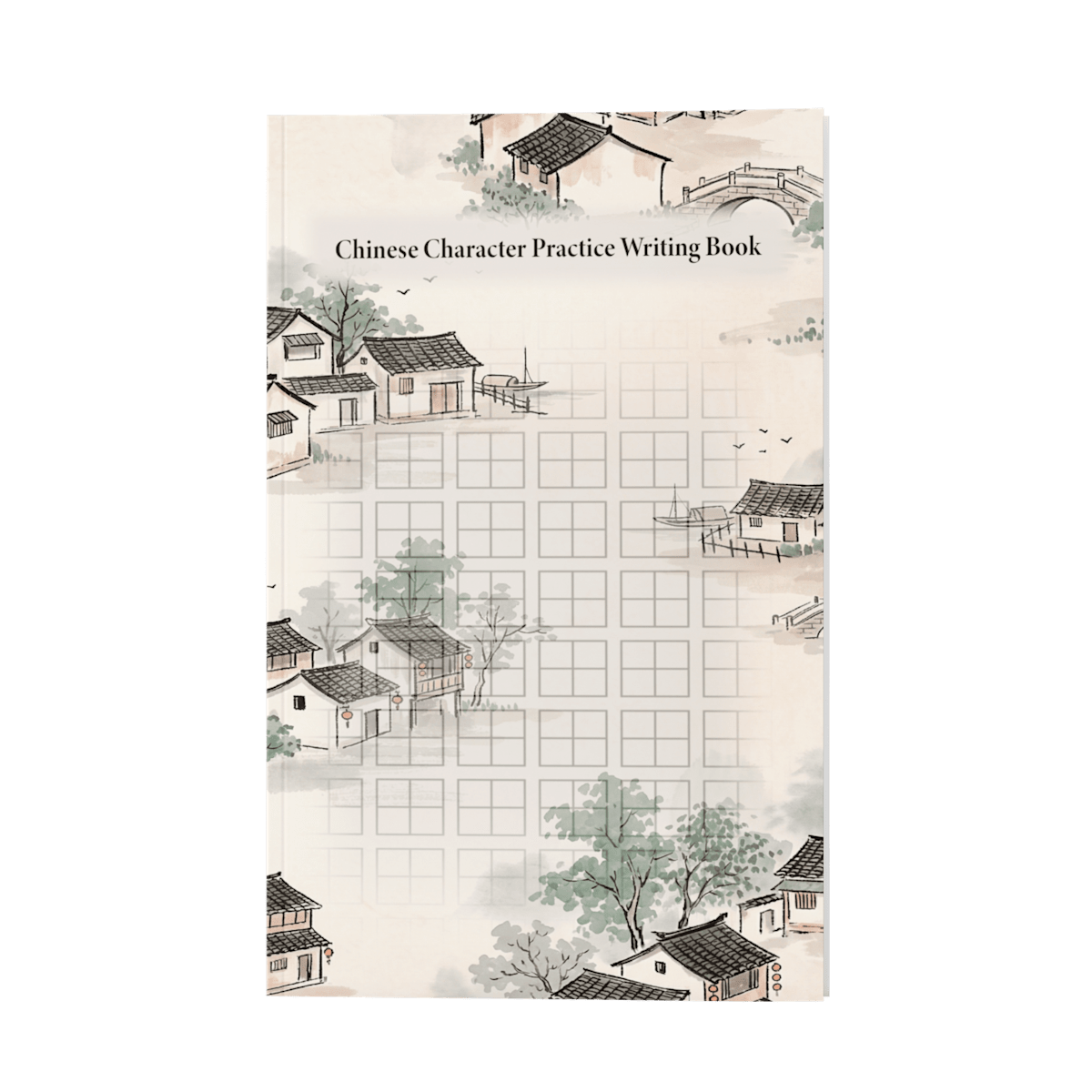
If you want an easy, distraction-free way to practice using Tianzi grids, you can take a look at this writing notebook here:
👉 https://nichenotespress.com/books/chinese-character-practice-writing-book

What you’ll learn from the video
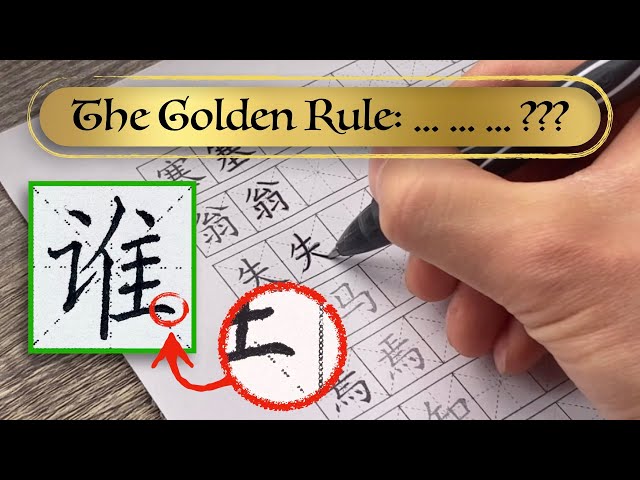
This video highlights several key ideas that are especially relevant when comparing grid paper and plain paper, including:
- Why neat handwriting depends more on structure than speed
- How spacing and proportion affect overall character appearance
- Common habits that lead to uneven or cramped writing
- Practical tips for improving consistency across characters
Seeing these principles demonstrated visually helps clarify why grid paper is so effective during practice.
How this connects to grid-based practice
Many of the issues discussed in the video — drifting characters, inconsistent size, and crowded strokes — are exactly the problems that grid paper is designed to solve. A visible frame makes spacing and balance easier to control, especially during repetition.
Using grid paper while applying these principles can help turn neat handwriting from a goal into a habit.